DEAR TELEVISION at PRESS PLAY!

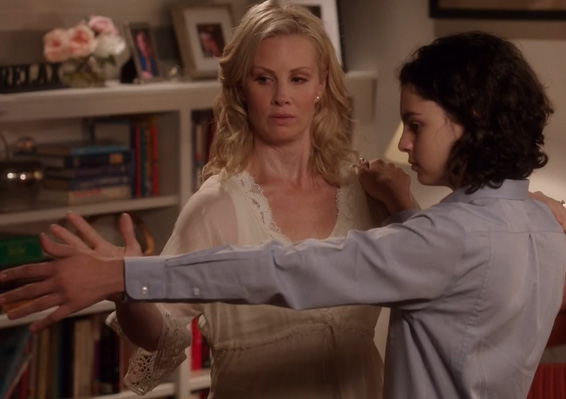
parenthood-dance-monica-potter-max-burkholder

Dear Television is back this week for the fall 2013 season. Starting next week, we’ll be covering a wide range of topics weekly for The Los Angeles Review of Books. This week, however, we’re writing a guest column at Indiewire’s great Press Play blog.

The theme of our column is the First Annual Dear TV Emmy Anti-Prom, and we’ll be showcasing the snubbed, the losers, and all the other kids who didn’t get invited to the dance.  Here’s my first post on Emmy-bait vs. Oscar-bait, popularity vs. prestige, and the snubbing of Parenthood‘s amazing Monica Potter.

“Monica Potter’s Field”

KILL THE LEADING MAN: 21st Century TV

pare

I wrote a long review-essay for The Los Angeles Review of Books about absent women, difficult men, the canon of television’s new golden age, and why online television criticism will save us all! It addresses new books by Alan Sepinwall and Brett Martin.

“If there were few female voices at the helms of these shows, their reception was shaped by a discourse community with a strong female — and, more often than not, feminist — undercurrent.”

Here it is!

ZEALOT: The Life & Times of Jesus of Nazareth

Ben-Hur-und-Jesus-begegnen-sich-im-Film-von-1959

I’m very proud to have contributed a piece—”On the Art of Rabble-Rousing”—to the Los Angeles Review of Books symposium on Reza Aslan’s controversial/ordinary new Jesus biography, Zealot: The Life and Times of Jesus of Nazareth alongside Andrei Codrescu and Kevin Hart.

“This backlash is not surprising. There is a long tradition of biographies of Jesus — and, along with it, an equally long tradition of controversy. Zealot is now officially part of both, serving as both a compelling new narrative retelling of the life of Jesus Christ and, thanks to its author’s personal faith, a flashpoint for very contemporary strains of Islamophobia and anti-intellectualism in the media.”

My piece is here, and the symposium is here!

MAD MEN / “In Care Of”

incareof

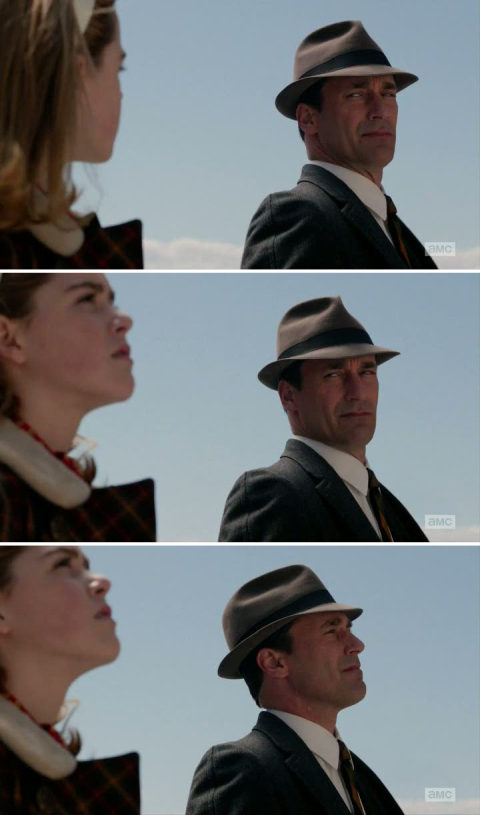
“What Sally Sees”

I close out Dear Television’s coverage of Mad Men, Season Six at The New Republic with a close look at the season’s closing scene. All my pet theories—Don’s de-centering as protagonist, the ascendance of Sally and Peggy as the show’s primary points-of-view—come home to roost.

“As the song plays out and the last frame of the season shows Don and Sally looking ahead together, with Don’s face in focus and Sally’s blurred in the foreground, we mirror the camera’s priorities by wondering what Don is thinking, what kind of revelatory vision he’s had. But we know that’s not the point and now so does Don. It’s what Sally sees that matters.”

We’ll be back in the fall!

MAD MEN / “Favors”

favors

“Draper / Nixon”

For Dear Television at The New Republic, I argue that Mad Men‘s eleventh episode reveals Sally as the show’s secret protagonist and Don Draper as a certain disgraced ex-president.

“If Walter White is ‘the one who knocks,’ Don Draper is the one who watches. And, in this way, Don Draper’s particular kink becomes emblematic of the sexist and racist culture at Mad Men’s core. The ability of white men to lay claim to the position of the spectator, observer, and overseer—and thus to control the way they are themselves seen—is the key to their social dominance. And, of course, big things happen when that position is compromised. The founding crisis of Mad Men may well have been the moment Peggy Olson got to stand on the other side of the one-way mirror in the Sterling Cooper testing room.”

MAD MEN / “The Better Half”

betterhalf

“Status Quo Ante Bellum”

Here’s my take on the ninth episode of Mad Men’s sixth season:

“Even Betty’s body became a (lecherous) object of nostalgia this episode. It’s hard to tell whether Matthew Weiner more enjoys punishing January Jones by putting her in that fat suit or leering at her after she’s allowed out of it.”

MAD MEN / “For Immediate Release”

something.emerson

It’s me again, for Dear Television at The New Republic.

“The Great Man Theory”

“As Emerson puts it, ‘Other men are lenses through which we read our own minds,’ and Don Draper, thus far, has been ‘Mad Men’’s primary lens. But Emerson also writes, ‘We are tendencies, or rather, symptoms, and none of us complete.’ Don Draper will never leave our purview, but ‘Mad Men’ is becoming mercifully more interested in highlighting his incompleteness, the ways in which those actions that might have previously scanned as heroic in context of his inner depravity, are in fact symptoms of that depravity.”